

Since PM Narendra Modi used the phrase ‘Dimagi Naxal’ in his Independence Day speech, delivered on 15th of August from the ramparts of the Red Fort, there has been endless speculation by his supporters and critics about what it means and signifies. My own first reaction was to laugh it off as merely old wine in a new bottle, a new phrase for an old group of left-leaning elites his party has long considered anti-national and labeled urban naxals, andolan jeevis, tukde tukde gang and so on.
But we must not forget that the PM delivered this speech only a few days after losing face to a youth-led protest movement that had forced him to sack a senior Minister. I think its safe to wager that the PM, an astute political communicator, targeted his speech at assuaging youth concerns. What does the moniker Dimagi Naxal signify in the light of this youth-focused messaging? I examined the transcript discursively to find out.
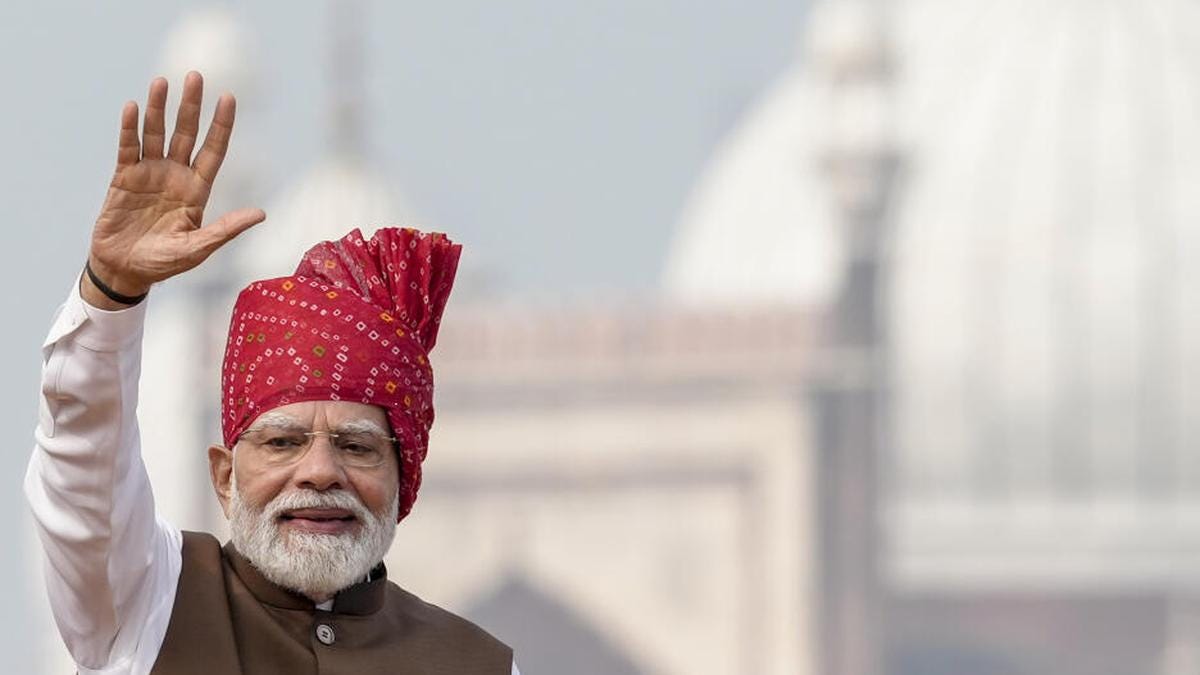
Placing youth at the centre
India at 80 finds itself in a bind when it comes to its youth. Over half the country’s population is less than 30 years old. In theory, India’s demographic dividend is expected to peak between 2030-2040, when low dependency ratios (in plain speak, more working age people, less dependents like children and elders) can potentially boost economic development by allowing greater savings, better labour productivity and higher investments in health, education and infrastructure. In practice, though, the young find themselves facing widespread under-employment and structural barriers to affordable and quality education. These frustrations have come to the fore in the recent protests.
The PM’s I-Day speech took heed of these mounting frustrations and directed itself towards the nation’s young. Youth were addressed as a priority category whose economic participation and rising aspirations can power India’s growth story.
The youth have a very important role to play in the journey towards a ‘Viksit Bharat’. Not only that, the greatest beneficiary of a ‘Viksit Bharat’ will also be the youth of my country. Therefore, we must take forward the goal of a ‘Viksit Bharat’ by connecting it with the aspirations and participation of our youth. We must move forward with our youth as our highest priority.
In the 2026 I-Day speech, the PM positioned youth as instrumental to self-reliant nation-building. In the seven streams (Sapta Dhara) that would contribute to nation-building - manufacturing, agriculture and food production, AI and digital technology, connectivity and logistics, defence and cyber security, green and blue economy, and India’s soft power, including yoga, handicrafts, the creative economy, music, tourism, sports, etc. - he specifically envisaged youth contributing in the areas of digital entrepreneurship, the start-up economy, bio-economy, aviation, and sports. He cemented his vision with two commitments - one, to train one crore young people in AI skills, and the second, to conduct a sports talent-hunt campaign and offer specialised training to those selected.


Surprisingly, the PM gave relatively less attention to the subject that lay the heart of student protests. He limited his focus on access to higher education, emphasising the increase in the number of universities and medical seats and the expanded availability of international education within India. Schools found no mention at all, clearly a missed opportunity. Evidently, the PM did not pre-empt that schools would be the key focus of the Cockroach Janta Party’s post Jantar Mantar activities.
The PM’s attention to the subtext of the protests, however, is visible in his offer to “provide free online coaching for young people preparing for various examinations”. The cost of coaching has been a significant pain point for NEET and public exam aspirants in general. ‘Free coaching’ might be an audacious offer, but it is a smart one because it acknowledges pain and puts forth a remedy. It will be worth tracking how this will get implemented.
The pressure of coaching classes has become a major burden for our middle-class families. Every parent feels that if they do not send their child to a coaching class, they are not keeping up with the expectations of society. Keeping the concerns of these poor and middle-class families in mind, we want to save them the thousands of crores of rupees they spend, allow their sons and daughters to remain close to home, ensure that they can be cared for, and prevent an economic burden from falling on the family. Therefore, we have decided to provide free online coaching for young people preparing for various examinations. We have the digital public infrastructure, we have excellent talent and we have teachers. By bringing these resources together, we are going to build an extensive network to provide free coaching to the young people of the country.
Overall, the PM’s speech acknowledged the political moment by placing the young at the heart of India’s growth plans and demonstrating intent to open new pathways for youth advancement. However, a discursive reading shows that it placed youth inside a pre-decided framework for Viksit Bharat and demanded their participation in nation building on terms set by an aging leadership that seems to care more about how parents will meet societal expectations than about what the young want on their own terms.
Youth and the Dimagi Naxal
It is against this preconceived and paternalistic understanding of youth that the term Dimagi Naxal ought to be read. If we dwell on the words that describe this new category of unsavoury citizens, it is significant that the PM sets the stage by alluding to armed Maoist rebellion, a constant challenge that successive governments in independent India have faced for decades. The eradication of Naxalism has been a regular feature of I-Day speeches, and a legitimate point of prideful achievement for the Modi government. Recently, the last of India’s armed Naxals retired, allowing the government to claim success in “winning back” tribals who were misguided and brainwashed by subversive elements, mostly intellectuals and ‘urban Naxals’ who, the government claims, advised on policy matters without doing enough for the tribal communities on ground.
When you gave us the opportunity to serve in 2014, we made a resolve on that very day to free the country from Naxalism. Today, I am happy to say that Naxalite-Maoist violence may no longer even have the strength to take its final breath. We are moving towards eliminating it completely. In areas where Naxalites once fired their guns, where the land was once stained with blood, today, in those very Naxal-affected regions and areas, the Tricolour of development, trust and endeavour is flying high because they have been freed from Naxalism.
But we must not underestimate this challenge. We need to be even more cautious about this challenge. For years, individuals with a Maoist ideology had made their place in the corridors of power in the country. Even as advisors on government committees, this Maoist ideology influenced policy.
The drawing of an arc from the violent Naxalism to left-leaning policy actors is a familiar move, but it does very specific work in the context of this speech. This time, the Naxal mindset is posited as a danger, not for tribals or policy, but for the nation’s youth.
We have succeeded in eliminating armed Naxals from the forests and liberating the country from that menace. However, while the armed Naxals are gone, the ‘Dimaagi Naxals’ remain, and these ‘Dimaagi Naxals’ are on the lookout for an opportunity. They are looking for ways of violence and anarchy. They are resorting to various tactics to drag society onto the wrong path. We must identify these ‘Dimaagi Naxals’, isolate them, and steer the nation’s youth toward the mainstream effort of transforming India into a developed nation.
A discursive reading of the above paragraph conjures an image of coercion. One set of people - anti-national intellectuals who had power in the past - are pulling the country’s innocent and impressionable youth onto the wrong path. The wrong path is that of protesting and of speaking up against the system, as opposed to the right path of obedient conformance with what elders like parents, teachers, employers - and by extension the state and society - ask of them.
Adults as covert (and willing?) targets
This is the really clever twist in the PM’s speech that a cursory reading would miss. The young are not the targets of this new catchphrase. Rather, I believe the PM invoked the Dimagi Naxal to speak to the ecosystem of adults that controls and influences youth. His words were meant to urge this ecosystem to re-exert authority over youth in order to protect them wrong influences and cajole them into being compliant and docile subjects.
It is no surprise that such an hierarchical reading of the moment feels right to the PM, who presents himself both as benign patriarch and action-oriented leader. Such language is likely to land on adult citizens who are already baffled, if not threatened, by the dramatic social and behavioural shifts they observe in their children and wards. As a parent, I understand how easy it is to give into this impulse. After all, most of us grew up in homes where discipline was the norm. While dealing with our kids, we often wonder whether to give in to what appears to be “their way” or assert our authority as parents. After all we pay the bills, we know better, we have the benefit of experience, we rationalise.
The Dimagi Naxal label is a warning targeted at adults reeling from rapid generational changes. It asks them to do something that feels familiar and logical, i.e. re-assert power over the young. At a more insiduous level, its invocation is a deliberate attempt to charge everyday adult-youth interactions with an air of moral and nationalistic duty.
My plea is that we must not let the phrase itself distract us from recognising that we stand at a particular, and potentially transformative moment of youth expression and solidarity. India is in the midst of a generational rift that has scaled up beyond imagination, from our homes and parks to the consume the whole country’s imagination. This moment demands something different from us, perhaps that we listen to the young and try to understand them before we intervene, choose positions or take sides?
The young will be heard
A fortnight on since Independence Day, it is quite clear that the young are in no mood to simply listen. They continue to engage in protests, they write letters to principals and bureaucrats, make memes and reels, conduct social audits, and so on. They have written the older generations off, in toto, and are taking matters into their own hands.
Look past the polarised politics that your Instagram feed presents to you, and you see that village children are asking for better schools, farmer’s children are asking for a chance at stable employment, and urban youth are discovering new social worlds at protest sites. These are not right wing or left wing children. They are simply children, India’s children.
From their own representation of themselves, captured on numerous videos, we are able to construct them as a self-driven force fuelled in equal parts by frustration and hope. Their conviction and autonomy is apparent in their irreverence, their language of confidence and fearlessness, and their ability to laugh in the face of power. Trying to beat this tsunami with the proverbial rod would likely be an exercise in utter futility.
In truth, Dimagi Naxal has been rendered into a mere spectre. Because the young are choosing who to hold as inspiration. They have been let down for too long, and now, they are gravitating towards issues that resonate and towards figures whose politics speaks to their problems and tunes into their concerns without patronising them. To reach the young will demand an engagement with their material realities and aspirational imaginations. To gain their trust will take humility, civility, respect and a whole lot of sincerity. History will not forgive us adults for misreading the role we should play.
very well written, enjoyed reading this:)
Thanks for this, Mukta. Now. How do we develop the humility, civility, respect and sincerity so completely eroded in our governance, and dare I say it, from our society. Let's continue the conversation and also shape action?