

The Indian Prime Minister is making Instagram reels to communicate with Gen Z. If you are not watching these, and the reels that are being make about these, you are missing out on peak entertainment.
But I am beyond being entertained. There is another name for the emotion I am feeling, and it starts with an R (yes, it is a four letter word). Because what is unfolding in front of us is an Audacity Contest. Who can be more blunt, more manipulative, more blasé, more direct, more attention grabbing? This novice Modi vs. digital native Gen Z face off on Insta is more nail biting that the FIFA World Cup finals because it is not simply about winning. It’s about how much damage you can do, how much loss of face you can effect, how much blood you can draw when you scratch your opponent.
An uneven contest
We know this is not a fair fight. There is this Goliath and David quality to this contest that raises its stakes. The PM has the entire weight of the state machinery behind him and the mainstream media too, which has in the last few days come together to attack a young girl for using abusive language against Modi. And then is the troll army. That mass of despicable humans and bots who obey the dog whistle enthusiastically, predictably and oh so viciously.
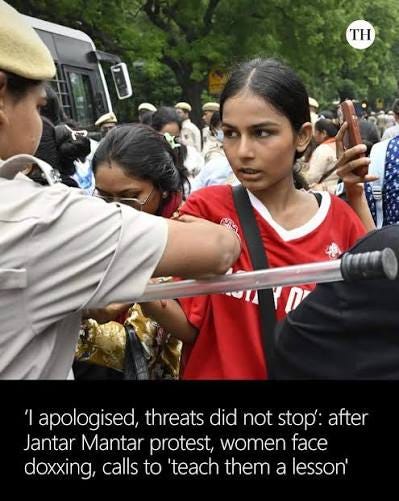
This pattern is not new. Doxxing and abusing outspoken women on the Internet is an established modus operandi. Back in February 2017, Gurmehar Kaur, then only 19 or 20, was viciously trolled on Twitter (now X) for speaking out against a right wing student outfit. This, among other incidents, brought attention on online abuse as a specialised form of sexual violence and there was much criticism of social media platforms for weak governance. There was, partly thanks to journalist Swati Chaturvedi’s 2016 expository book I am a Troll: Inside the Secret World of BJP’s Digital Army, a growing awareness that this online abuse was not organic, but rather a coordinated attack against critics of the government.
Once, there was naive hope
Back then in 2017, I was politically naive. I was shocked to find that a large number of online abusers of women were followed on Twitter by PM Modi and boasted of their connections to him. I refused to believe that he could be ok with this. I had hope that the man occupying the country’s second highest office would do the right thing by the women of this country.

And so, I expended a lot of energy in putting out a Change.org petition titled PM Modi, help us end online sexual abuse. The petition, which I was reminded of by a friend yesterday, is still technically alive. If you are curious, you can go online and read the full text but broadly, I appealed to the PM to:
Publicly denounce abusive online behaviour directed at women
Unfollow these accounts and rebuke them
Act against political leaders who engage in online sexual abuse of women
I believed that these actions would send out a clear message to online predators and abusers “with no ambiguity whatsoever” and that such steps have the potential to “trigger an important change in mindset and lead to a gender positive society.”
How the tables did turn
Cut to today. Young women are raging in public and the same man is having a meltdown. He who silently endorsed serial abusers is playing the part of the victim who is being trolled by young Indians. He is upset about bad language. He is lecturing “the daughters” of our country, asking them to behave with more restraint and in line with our “culture”.
Well, what goes around comes around. Needless to say my petition, which garnered over 25,000 signatures back then, or any other requests to pay attention to the online sexual abuse women face received no attention from the PM. His past silences have played no small part in normalising the despicable language that the young are now weaponising against the establishment. Irony, already dead, is now resurrected and dancing wildly on every neem tree.
The young will not stop making memes and the machinery will not stop raining down on them. But the mask is now off. And those who are offended by the abusive language of student protestors, particularly women, must think about how this language came to infiltrate the minds and hearts of our youth. Who shouted the choicest abuses at Muslims, at women, at Dalits, at protestors asking for citizenship assurances, at farmers asking for a fair hearing? Who lynched and kicked and made a public spectacle of violence? Who rewarded those who flouted every norm of decent behaviour?
It is to credit of this country’s youth that they did not learn these lessons well. For every gaali uttered during these protests, there are a hundred harmlessly funny memes. For every act of uncivility, there are thousands of stories of bonhomie and friendship and compassion from the protest sites across the country. A very angry generation of powerless Davids used whatever language they could muster - love, jokes, insults - to shake an old and disconnected Goliath out of his complacence.
As Anand Teltumbde has pointed out in a recent piece, not only did the student protests brilliantly re-appropriate the now infamous “cockroaches” insult directed at them and turn it into a collective identity, their abusive language should be understood as a deliberate transgression to strip authority of the reverence and respectability they think they automatically stand for. He writes:
There is a crucial distinction between abuse directed downward, at women, minorities or other vulnerable groups – which merely reproduces the structures of domination – and profanity directed upward, at entrenched institutions of power. The Cockroach idiom, whatever its liberal critics made of it, was aimed unmistakably at the latter: at a Chief Justice’s bench, a minister’s office, a party machine and system’s impunity.
Directed upward, transgressive language becomes an act of symbolic insubordination, stripping authority of the reverence much of its power depends on. Seen this way, the Gen Z idiom of the agitation was more than youthful irreverence – it was the expression of a generation’s accumulated frustration with unemployment and examination scams, communicating emotion as much as demands, and narrowing the distance between the movement and its social base in a way respectable language rarely manages (emphases mine).
He gets by with a little help from his fraands
Between being a petitioner for Modi’s grace in 2017 and today, I have lost my political naiveness. So let me name what I feel right now, as I see young women who participated in a Constitutionally legitimate protest against a corrupt and defunct education system get threatened with death and rape.
What I feel is RAGE. But this rage is not just directed against those who are shamelessly orchestrating this while they hide inside the safety of their high security homes and offices. It is also directed against the good people of this country who have allowed this to happen.
When I went back to re-read my 2017 petition, what struck me was that several signatories of that petition are today ardent Modi supporters. Some of them have dutifully posted content about how offended they are with the abusive language of young protestors. Others have called attention to the respect owed to the PM and his office. One or two have started posting anti-reservation content. Plainly put, a number of those who signed a petition that linked online abuse to PM Modi and asked him to stop dog whistling, are today themselves obediently heeding that whistle’s call.
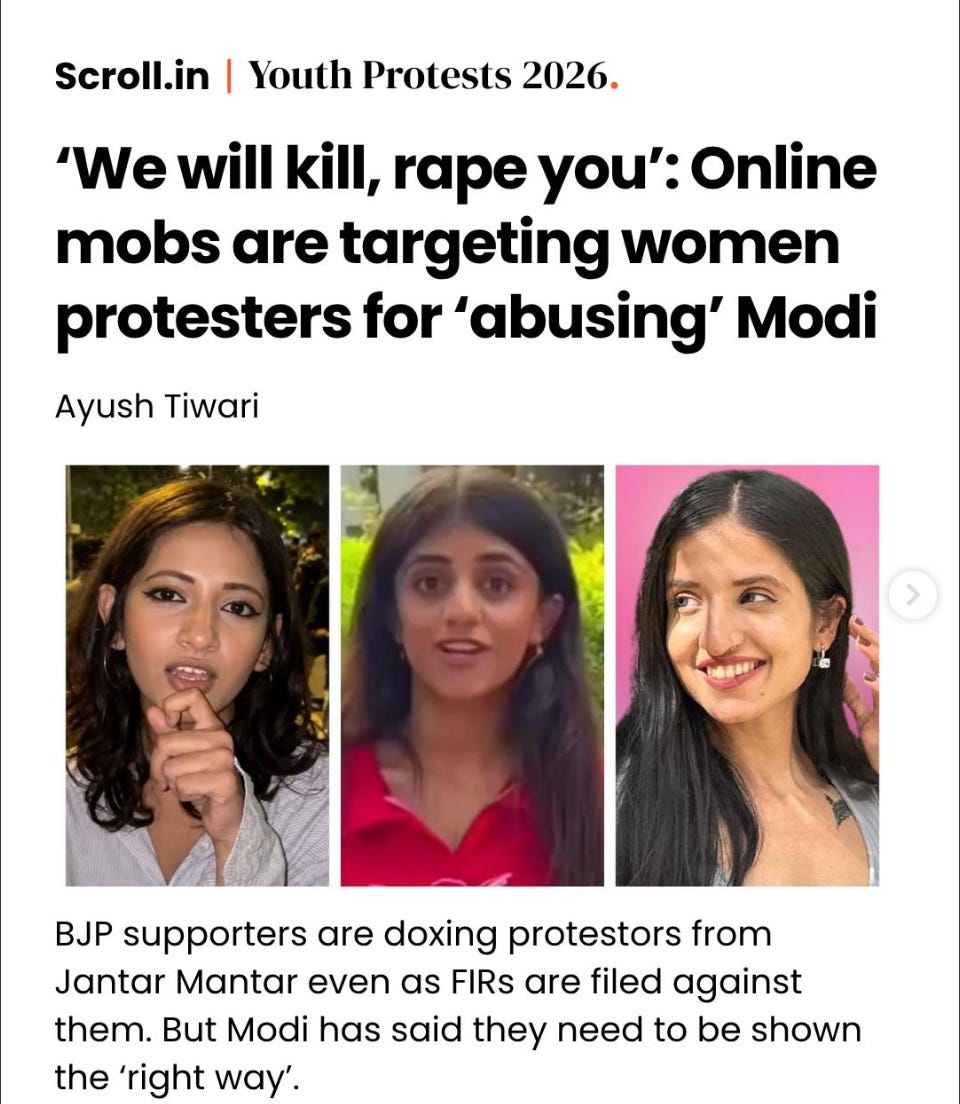
I understand today that the PM’s ability to lecture female protestors about abusive language in the immediate aftermath of his own government unleashing police violence against defenceless students does not come from nowhere. It is enabled by those I considered decent folk - those sweet uncles and aunties, honest professionals and hardworking business people who speedily adopted the safe narratives of the ruling dispensation as it became obvious that dissent would not be tolerated. We are at this point because of their sacrifice of personal values and their silence when the minorities were being lynched, when activists were being jailed for asking questions, when social programmes as important as the MGNREGA were being truncated, when migrant workers who faced the economic setback of COVID were being picked up and put in detention centres inside their own country, and now, when a fresh lot of students - even their own kids - were being lathi charged and tear gassed.
Perhaps voices of those who speak out are systematically silenced because they make the mainstream so intensely uncomfortable about their complicity. The thrashing limbs of dissenters are held still by legions of regime acceptors - they are teachers, parents, friends, colleagues, all respectable people who have simply chosen to succumb because it became too costly to fight, or because they had nothing to lose either way.
Understand the rage of young women
In these years, I have learnt that the people of our country tolerate the vilest of men who cuss with pride and boring regularity but cannot bear the boldness of little girls. That patriarchy flows smoothly through the veins of our countrymen and women such that they police and surveil anyone with an independent thought in their head, and think it is national duty.
As much as these protests brought the young together behind a cause that affected them all - the country’s broken education system and their dwindling employment prospects - it is undeniable that the stakes are higher for the girls. The young lady who came to Jantar Mantar dressed as a bride drove the message home. Young women from Indian families do not get many chances to carve out independent lives. It is that one exam, that one interview that stands between them and an arranged marriage. Their dreams have less space, their aspirations are often not even on the discussion table.
It is in this light that we must see the participation of young women in these protests. They have given themselves the permission to feel and express rage at the lost opportunities and the broken system but also the endless gender discrimination, the abuse, the violence, the repression. They are choosing to resist by being angry and bold and outspoken and even funny because the other option is a life in chains.
So today, if you are watching the Audacity Contest play out between the PM and Gen Z, think carefully about where you stand. In this highly unequal contest, do your sympathies lie with a man who chooses to place his personal hurt over the legitimate demands of young women for basic freedoms and dignity? Are you on the side of the all-powerful leader who looks the other way when young women are doxxed and hounded, and who publicly infantilises and patronises them? Or do you stand behind the rage-filled courage of this country’s young women as they seek to boldly grab his attention and direct it towards their legitimate problems?
No one outside India would fully know about all this until your post. Some prominent women in government and the arts are supporting Gen Z response to verbal abuse and physical harassment of against protesting women students. Women in India have so much less opportunity to create an independent life than men. Men should always remember that the human spirit has no gender and that the futures of women and men are equally important for their mutual survival and for the survival of India (and the rest of the world)!
Very well highlighted. As the saying goes, as you sow, so shall you reap.
Those who are aghast today because the PM is being abused were conspicuously silent when his supporters routinely abused the weak and the marginalized. For years, right wingers and paid trollers have targeted intellectuals, artists, comedians, Muslims, Dalits, and now even the young with relentless invectives.
This coarsening of public discourse did not emerge overnight; it is the inevitable consequence of normalizing abuse as a political tool. So, Sir, spare us the outrage now. If abuse was acceptable when directed at others, it cannot suddenly become intolerable when it reaches your own side.